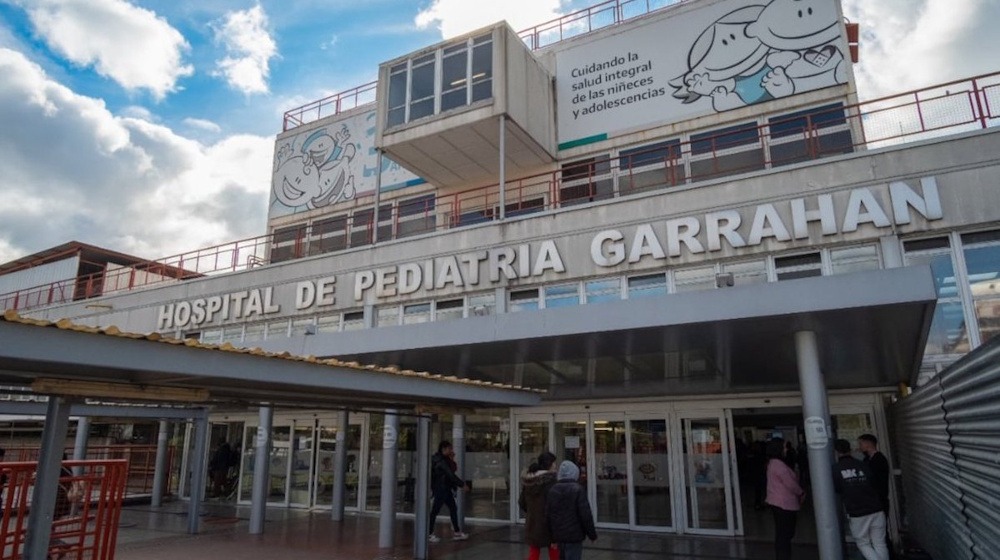
Employees at the Garrahan Children’s Hospital have been granted a 61-percent increase in base salary, effective retroactively from October and encompassing permanent staff, government-contracted personnel, residents, and research fellows. Union leaders expressed approval of the increase on Wednesday. Salaries now approach “the minimum cost of maintaining a family,” stated Alejandro Lipcovich in an interview. Since assuming office in December 2023, President Javier Milei has implemented a stringent fiscal adjustment program that has significantly impacted the public sector, notably affecting personnel at Garrahan, Argentina’s premier pediatric institution. “Thanks to joint work with the national government,” the hospital’s management stated on Tuesday, “a recognition of workers has been consolidated through a pay rise of nearly 60 percent” for permanent staff, public employment contractors, fellows, and residents.
Internal figures suggest that the initial compensation for a physician engaged in a 42-hour workweek is set to increase from 1.2 million to 1.6 million pesos, which corresponds to US$814 and US$1,085, respectively, inclusive of retroactive payments. The measure will be supplemented by fixed bonuses implemented in September, which collectively suggest an effective rise of between 35 and 40 percent in net income, as per reports. Workers have celebrated the measure as a significant achievement in their ongoing efforts and for the enactment of the Paediatric Emergency Law, which designates supplementary funding to hospitals across the country. The legislation received Congressional approval in August; however, it was subsequently vetoed by Milei in September, who contended that it would jeopardize his fiscal surplus, a fundamental component of his economic strategy. In October, Congress successfully overturned the veto, marking a significant political setback for the President. Milei has since only partially enacted the bill into law, insisting that lawmakers first assess its cost to guarantee fiscal balance.
“This increase, even if they don’t call it that, is the application of the paediatric health emergency law,” stated Norma Lezana, in a video shared on social media on Wednesday. In an internal statement, the Asociación de Trabajadores del Estado (ATE) state-workers union characterized the deal as a “historic triumph” attained “in the face of attempts to delegitimise the claim,” while also highlighting that wage deductions imposed during the strike have not yet been reimbursed and that the Paediatric Emergency Law is still only partially enforced. Opposition lawmaker Julia Strada, who leads the private Centro de Economía Política (“Centre for Political Economy,” CEPA), stated on social media that the wage increase reinstates lost purchasing power and signifies a one-percent real-term rise relative to salaries as of November 2023.
Despite the increase in compensation, healthcare professionals caution about persistent challenges: insufficient staffing in wards, deferred surgeries, delays in appointments, and a continuous migration of specialists to the private sector. According to estimates, over 300 professionals have resigned in the last year. “It’s a huge achievement made possible by the perseverance of workers, families and lawmakers who stood by us,” stated Georgina Duarte. “It’s not everything we asked for, but it represents a significant milestone.” Numerous individuals found it challenging to sustain their livelihoods, illustrating that perseverance can lead to the attainment of respectable employment. Gerardo Oroz, a fellow union delegate, characterized the increase as “a break from the public-sector wage ceiling.” However, he cautioned that numerous staff members are still on temporary contracts and that ongoing supply shortages are hindering hospital operations. For several months, the areas surrounding Buenos Aires and the Garrahan Hospital have witnessed a significant presence of students, educators, medical professionals, and healthcare personnel engaging in protests, public demonstrations, marches, and strikes, all advocating for an increased budget for the institution. In the midst of the conflict, “around 300 workers from different areas have resigned,” Lipcovich informed.